
PVsyst Lesson 3: Tilt, azimuth and horizon, how yearly irradiation changes with each
In the PVsyst Orientation window the 15° tilt is changed to 0°, 30° and 40° and the azimuth to ±30° to read the transposition factor and yearly irradiation, then distant hills are added in Horizon.
Lesson summary
The narration is in Korean with English subtitles (CC). The text below follows the narration. All examples are virtual plants.
Lesson 3 changes Plane tilt, Azimuth and Horizon on screen and reads the effect. The example is the virtual Example Roof 1 MW with a reference of 15° tilt facing due south, azimuth 0°. A Main parameters button in orange still needs checking, and green means it is done.
Field type in the Orientation window stays at Fixed Tilted Plane. In PVsyst, due south is 0°, east is negative and west is positive. At 15° the Transposition Factor is 1.13, the loss with respect to optimum is −6.6 % and the yearly irradiation on the plane is 1,601 kWh/m². Laid flat at 0° the values are 1.00, −17.5 % and 1,413, the same as the horizontal irradiation from lesson 2. At 30° they are 1.20, −0.8 % and 1,699, and at 40° they are 1.21, 0.0 % and 1,713, the Quick optimization result from the clear day model. Roofs are often set at a low 15° because of row shading, wind and roof loads.
One common mistake. In a project that already has a 3D scene, like this roof with 18 rows, changing only the tilt in this window shows red text such as 18 fields in error, mismatch 15.0°. The tilt in the 3D scene must be changed as well, which is covered in lesson 6.
Turning the azimuth to −30°, facing south east, gives 1.11, −8.1 % and 1,574, and +30° facing south west gives the same. That is 1.5 percentage points below the −6.6 % for due south. In the Optimization box, Winter (October to March) moves the optimum tilt to about 60° and 15° becomes −20.8 %, while Summer (April to September) puts 15° at −0.2 %, almost optimal. The optimum tilt differs by season. Cancel discards the changes.
In the Horizon window the yellow bands are the sun paths, June 22 above and December 22 below, and the red line is the horizon. Setting point 2 at azimuth −40° to 10° and point 3 at +40° to 20° puts hills to the south east and south west, and from November to January the sun is hidden around 2 to 3 p.m. On this example site 40° is optimal, 15° is −6.6 % and turning 30° away from due south is −8.1 %. Try it yourself: set the tilt to 20° and read the Transposition Factor. A value between 1.13 and 1.20 is right.
Screen menus and key numbers
Screen menu names
| On screen | What it is |
|---|---|
| Main parameters | Required settings (orange needs checking, green is done) |
| Orientation | Tilt and azimuth window |
| Field type | Mounting type (Fixed Tilted Plane) |
| Plane tilt | Tilt angle |
| Azimuth | Orientation (south 0, east −, west +) |
| Transposition Factor | Irradiation on the plane divided by horizontal |
| Loss with respect to optimum | Loss compared with the optimum tilt |
| Quick optimization | Fast optimum from the clear day model |
| Optimization: Annual · Summer · Winter | Period used to find the optimum tilt |
| Horizon | Shading from distant hills |
| Read / Import | Load a horizon file |
| Cancel | Discard the changes |
Key numbers
| Item | Value |
|---|---|
| Reference | 15° tilt, azimuth 0°: 1.13, −6.6 %, 1,601 kWh/m² |
| Tilt 0° | 1.00, −17.5 %, 1,413 |
| Tilt 30° | 1.20, −0.8 %, 1,699 |
| Tilt 40° (optimum) | 1.21, 0.0 %, 1,713 |
| Azimuth ±30° | 1.11, −8.1 %, 1,574 |
| Winter (October to March) | optimum about 60°, 15° is −20.8 %, 703 kWh/m² |
| Summer (April to September) | 15° is −0.2 %, 898 kWh/m² |
| Horizon example | 10° at −40°, 20° at +40° |
Frequently asked questions
Is south 0° for azimuth in PVsyst?
Yes. In the Orientation window, Azimuth is 0° at due south, negative toward the east and positive toward the west. A south east orientation of 30° is entered as −30°.
Red text appeared after I changed the tilt. Why?
In a project with a 3D scene, changing only the numbers in the Orientation window makes them disagree with the scene and PVsyst warns. Change the tilt in the 3D scene as well (lesson 6).
What is the Transposition Factor?
The yearly irradiation on the tilted plane divided by the horizontal irradiation. In the example, 15° gave 1.13, 30° gave 1.20 and 40° gave 1.21.
Previous and next lesson
Lesson files
All files are free to download right away
No sign up and no subscription needed. If the lessons help you, please consider subscribing to our YouTube channel.
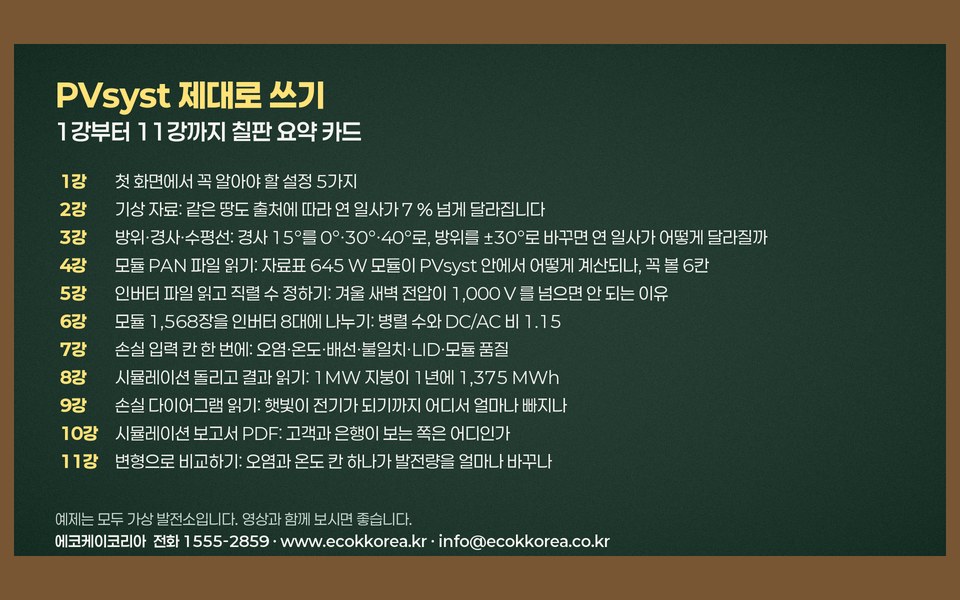
PVsyst lesson cards, lessons 1 to 11
The chalkboard summary from the end of each lesson, plus a lesson list. In Korean.
Download (PDF 2.7 MB)
Other lesson files and sample reports are on the Lesson files page. Files are for study and reference. Numbers in the examples come from virtual plants or cases with the location removed. Most files are in Korean.