
PVsyst Lesson 4: Six fields to check in a module PAN file (645 W module)
Reading a PVsyst module PAN file on a 645 W bifacial module: rated power and tolerance, Voc and Isc, Vmp and Imp, cell structure, temperature coefficients and bifaciality factor.
Lesson summary
The narration is in Korean with English subtitles (CC). The text below follows the narration. All examples are virtual plants.
Lesson 4 shows how module data is stored inside PVsyst and reads the six fields to check in one PAN file. The System button opens the window for modules, inverters, series and parallel. The example has eight sub arrays, each with one inverter, and the first one already has an HD Hyundai Energy Solutions 645 W bifacial module selected. Press Open and the PAN file opens.
Field one is the nominal power of 645 W at standard test conditions, 1,000 W/m² and 25 °C. The tolerance next to it, +0.8 %, is the +5 W from the datasheet written as a percentage, and because of it the Module quality field in lesson 7 becomes −0.2 %, a gain rather than a loss. Field two, open circuit voltage 57.61 V and short circuit current 14.14 A, sets the number of modules in series and the fuses. Field three, maximum power point voltage 47.58 V and current 13.56 A, multiplies to 645.2 W and matches the nominal power.
Field four, the cells are 78 in series in two parallel strings, 156 half cells, and shading losses are calculated with this structure. Field five, the temperature coefficients: for each 1 °C rise the voltage drops 0.138 V and the power 0.29 %. On cold days the voltage rises instead, which is why the series count in the next lesson needs it. Field six, the bifaciality factor of 0.80 means the back side produces 80 % as much as the front. On a roof little light reaches the back, so the gain is small.
The size is 1.134 × 2.465 m and the weight 34.7 kg, and 645 W divided by the area gives an efficiency of 23.1 %. Some values are not on the datasheet: shunt resistance 600 Ω, series resistance 0.226 Ω and gamma 1.04. They set the efficiency on cloudy days, so if they are wrong the yearly yield can be off by several percent. For this module the efficiency at 200 W/m² is −2.8 %. No red warning at the bottom means the datasheet values and the calculated values agree.
If these six fields are correct the module can be trusted. In real projects many new modules are not in the list, and the file you receive often differs from the datasheet or test report, so we check these six fields against the test report one by one before every design. The next lesson opens the inverter file and calculates how many modules can go in series at −15 °C.
Screen menus and key numbers
Screen menu names
| On screen | What it is |
|---|---|
| System | Modules, inverters, series and parallel |
| Sub-array | Group of modules on one inverter |
| Open | Open the module PAN file |
| Pnom | Nominal power |
| Tol. −/+ | Power tolerance |
| Voc · Isc | Open circuit voltage · short circuit current |
| Vmpp · Impp | Maximum power point voltage · current |
| Nb cells in series | Cells in series |
| muVoc · muPmp | Voltage · power temperature coefficients |
| Bifaciality factor | Rear side output as a share of the front |
| R shunt · R serie · Gamma | Shunt resistance · series resistance · gamma (cloudy day efficiency) |
Key numbers
| Item | Value |
|---|---|
| Nominal power | 645 W, tolerance +0.8 % (+5 W) |
| Voc · Isc | 57.61 V · 14.14 A |
| Vmp · Imp | 47.58 V · 13.56 A (product 645.2 W) |
| Cell structure | 78 × 2, 156 half cells |
| Temperature coefficients | voltage −0.138 V/°C, power −0.29 %/°C |
| Bifaciality factor | 0.80 |
| Size · weight · efficiency | 1.134 × 2.465 m · 34.7 kg · 23.1 % |
| Not on the datasheet | Rsh 600 Ω, Rs 0.226 Ω, gamma 1.04 |
| Efficiency at 200 W/m² | −2.8 % |
Frequently asked questions
What should I check in a PVsyst PAN file?
Six fields: nominal power and tolerance, Voc and Isc, Vmp and Imp, cell structure, temperature coefficients and bifaciality factor, each compared with the module datasheet and test report.
How does a +0.8 % tolerance affect the yield?
It is the +5 W on the datasheet written as a percentage. In the PVsyst loss inputs the Module quality field becomes −0.2 %, which is a gain (lesson 7).
Why do shunt resistance, series resistance and gamma matter if they are not on the datasheet?
They set the efficiency on cloudy days, so wrong values shift the yearly yield by several percent. The lesson module was −2.8 % at 200 W/m².
Previous and next lesson
Lesson files
All files are free to download right away
No sign up and no subscription needed. If the lessons help you, please consider subscribing to our YouTube channel.
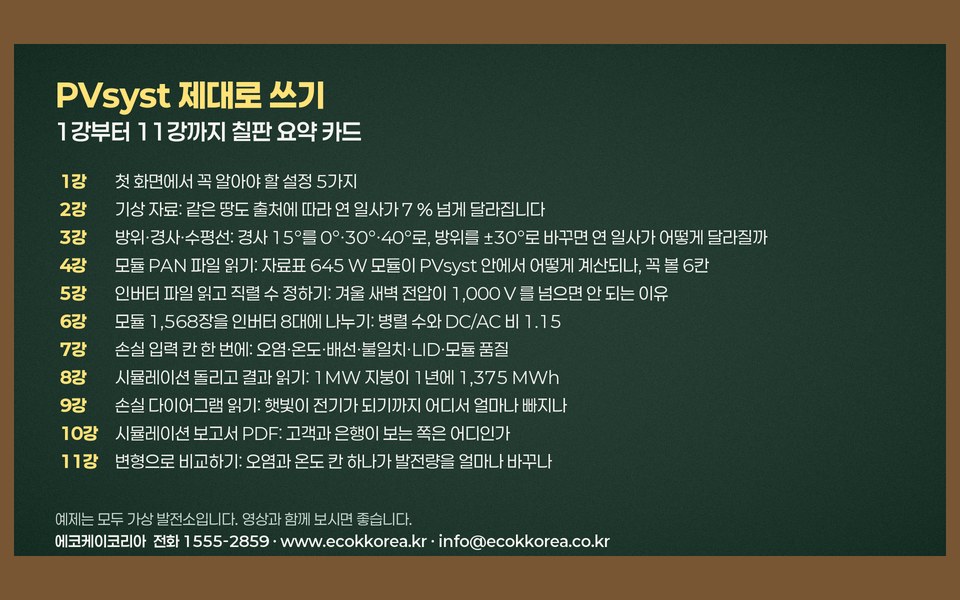
PVsyst lesson cards, lessons 1 to 11
The chalkboard summary from the end of each lesson, plus a lesson list. In Korean.
Download (PDF 2.7 MB)
Other lesson files and sample reports are on the Lesson files page. Files are for study and reference. Numbers in the examples come from virtual plants or cases with the location removed. Most files are in Korean.