
Solar project timeline in Korea: how long each stage really takes, from license to commercial operation
Dated timelines from two factory roofs (1.35 MW through the power exchange in 9.5 months, 558 kW under a KEPCO agreement in 12 months), the statutory day counts, equipment lead times and what runs in parallel.
The short answer
On the factory roofs we have taken from license to commercial operation, the whole process took 9.5 months for a 1.35 MW plant selling through the power exchange and 12 months for a 558 kW plant under a KEPCO purchase agreement. Construction itself was two to six months of that. The rest was permits, the safety corporation review and utility paperwork, and only a few of those steps have a statutory clock: 60 days for the license, an inspection request at least 7 days before the inspection, a certificate within 5 days of it, and a commencement report within 30 days of the first power sale.
The seven stages and who handles each are in our note on Korean solar permitting. This note is about time: how long each stage took on two real projects, which stages can run in parallel, what the law fixes, what the suppliers fix, and where the months were lost.
Two tracks, decided by size
Above 1,000 kW the power is sold through the Korea Power Exchange, which adds membership, meter sealing by the exchange and a trading start confirmation. At 1,000 kW and below the owner signs a power purchase agreement with KEPCO, which adds the contract paperwork and a KEPCO protection coordination review before the meter is sealed. The permits before construction are the same on both tracks.
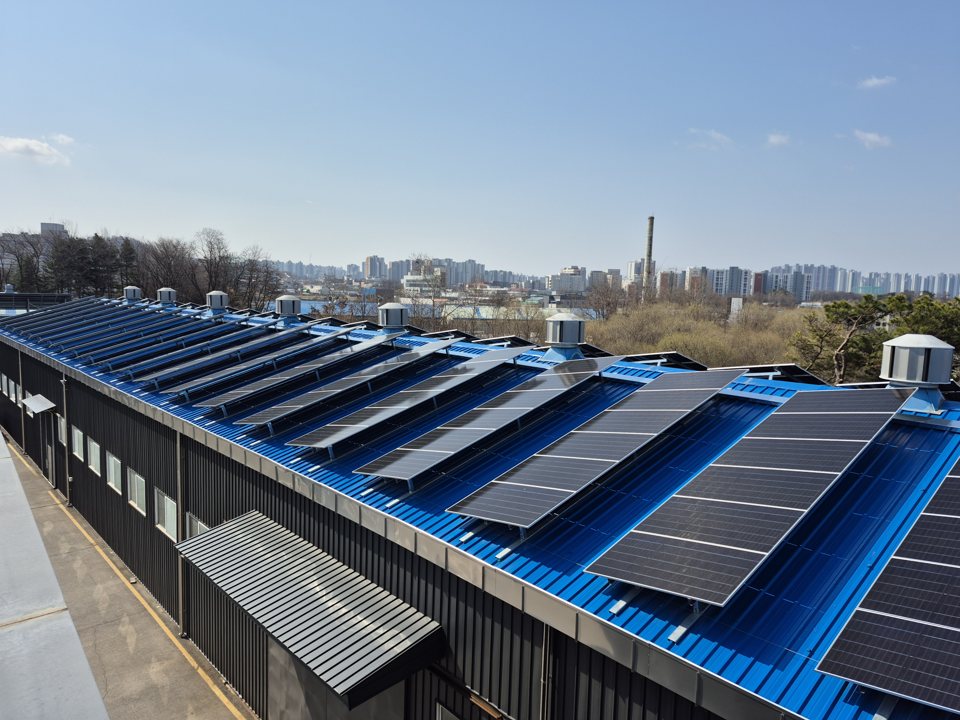
Timeline A: 1,349 kWp roof, Changwon, sold through the power exchange
| Date | Step | Elapsed |
|---|---|---|
| 17 October 2025 | Generation business license application | Day 0 |
| 24 November 2025 | License issued | 38 days |
| 15 December 2025 | KEPCO line use application and power exchange membership filed on the same day | Day 59 |
| 24 December 2025 to 6 February 2026 | KESCO pre technical review including seven supplements | About 6 weeks |
| 7 January to 6 February 2026 | Structure notification to the city, four supplements, accepted | 30 days |
| 26 February 2026 | Construction plan notification certificate | Day 132 |
| 7 February to 23 July 2026 | Construction: safety nets and guardrails, roof overlay, 2,108 modules, trays, substation, 14 inverters; two change notifications for rain and a ready mix concrete strike | 5.5 months |
| 23 July 2026 | Pre use inspection passed at the first attempt, certificate two days later | Day 279 |
| 29 to 31 July 2026 | KEPCO interconnection test and meter sealing, power exchange metering seal, trading start, commercial operation | Day 287 |
| 1 August 2026 | Business commencement report filed | 9.5 months from application |
Timeline B: 558 kW roof, Cheonan, KEPCO purchase agreement
| Date | Step | Elapsed |
|---|---|---|
| 1 April 2025 | Generation business license issued | Day 0 |
| April to August 2025 | Roof survey by drone, three reinforcement options for a 1989 slate roof, buildings changed | 4 months |
| 28 May to 1 July 2025 | Structure notification filed and accepted, later cancelled because the buildings changed | 34 days |
| 29 July to 1 September 2025 | Major repair permit for added beams and columns, processed with a new structure notification | 34 days |
| 21 August 2025 | License amendment from 737.1 kW to 560.16 kW after the building set changed | Day 142 |
| 26 to 27 August 2025 | KEPCO impedance data received, purchase agreement documents filed | Day 148 |
| 5 to 8 September 2025 | KESCO pre technical review, five supplements closed in three days | Day 160 |
| 17 to 25 September 2025 | Construction plan notification and building commencement report filed the same day; commencement accepted after one supplement | Day 177 |
| October 2025 to January 2026 | Building reinforcement, then modules on six buildings from 11 to 22 December, electrical work in January; change notification on 25 November extended the period to 31 March | 4 months |
| 11 February 2026 | Pre use inspection passed (22.9 kV, 558 kW) | Day 316 |
| 10 to 20 March 2026 | Purchase agreement signed, interconnection test with the KEPCO monitoring terminal, relay settings entered, meter sealed, commercial operation | Day 353 |
| 7 April 2026 | Business commencement report filed | 12 months from license |
What ran in parallel, and what could not
- The KEPCO application and, above 1,000 kW, the power exchange membership were filed three weeks after the license, while the structural and KESCO reviews were still open. They do not wait for the construction plan notification.
- On the PPA track the purchase agreement documents went in before construction started; the agreement itself was signed only after the inspection certificate. Inverter setting confirmations, meter test certificates and other supplier documents for the agreement were requested at the time of ordering.
- The extra high voltage switchgear and transformer take about 75 days from drawing approval to delivery in our schedules and must be ordered before the construction start date, which the notification itself permits because the notification concerns the work, not the purchase.
- The structure notification cannot be accepted until the building set is final; in Cheonan it was accepted, cancelled and refiled when the buildings changed, and the license had to be amended for the same reason.
- The pre use inspection cannot be requested until the notified plan and the built plant match, so every change of module, inverter or protection relay after the notification is filed as an amendment before the inspection request.
The clocks that are fixed
| Step | Period | Basis |
|---|---|---|
| Generation business license | 60 days statutory processing | Electric Utility Act and its rule |
| Site manager appointment notice | 7 days before the start of work | Electrical Construction Business Act Enforcement Decree, Article 12-2 |
| Supervisor assignment confirmation | By the construction start date | Electric Utility Act Enforcement Rule, Appended Table 8, note 4 |
| Construction plan notification | Before work starts; about 15 days to process in practice; amendments before the certificate period expires | Electric Utility Act Article 61(3) |
| Pre use inspection request | At least 7 days before the inspection date | Enforcement Rule Article 31(5) |
| Inspection certificate | Within 5 days of the inspection | Enforcement Rule Article 34(1) |
| Temporary use | Up to 3 months, extendable to one year | Enforcement Rule Article 31-2 |
| KEPCO connection administration | About 3 months: 2 months for the connection design and cost notice, 1 month for payment; a 22.9 kV connection of 5 to 10 MW or a new line has a 12 month sample schedule | KEPCO transmission and distribution facility use rules, Article 10 |
| RPS facility confirmation | Apply within one month of the inspection or certificates start from the application date | Korea Energy Agency guidance |
| Business commencement report | Within 30 days of the first power trade | Electric Utility Act Article 9(4) |
Durations we plan with
For a first schedule we use a model calibrated on our own projects. The figures are construction days from the first site work to the meter seal, with equipment ordered in advance, and before any weather or review delay.
| Plant | Construction days | Critical path |
|---|---|---|
| Roof, low voltage, about 100 kW | 41 | Rails, modules, string inverter, inspection, seal |
| Roof, low voltage, about 500 kW | 45 | Same, with longer rail and module runs |
| Carport, low voltage, about 500 kW | 50 | Concrete footings and curing, then steel |
| Roof, extra high voltage, about 1,350 kW | 98 | Interconnection switchgear manufacture, about 75 days |
| Ground, extra high voltage, 1 MW | 98 | Switchgear; civil 19, foundations 16, structure 20, modules 20, electrical 18 days |
| Ground, extra high voltage, 3 MW | 100 | Structure 38, modules 40 and stringing 34 days overtake the switchgear |
Supplier lead times behind the model: modules about 25 days, roof rails 14, ground structures 18, low voltage string inverters 21, extra high voltage inverters 45, low voltage boards 25, extra high voltage interconnection switchgear 75 and transformers about 75, the last to be confirmed with the maker for each order. July and August civil work is planned 15% longer for the rainy season.
Where the months went
- Reviews with supplements: seven KESCO supplements and four structure notification supplements in Changwon, five KESCO supplements in Cheonan. Almost all were mismatches between documents (module certificate numbers, relay models, string currents) and are avoidable with one cross check before filing.
- Weather and strikes: six weeks of rain and a ready mix concrete strike in Changwon moved the completion from 30 June to 31 July and required two change notifications.
- Roof decisions: four months in Cheonan between the license and a final building set, which then forced a license amendment and a second structure notification.
- Forms: the building department asked for the structural confirmation on a form with seismic items, and the engineer had to rewrite and seal it.
What to settle before the clock starts
- The final set of buildings and the capacity, because both appear on the license and on every later form.
- The structural review and the roof material survey, before the structure notification.
- The KESCO checklist items that produced supplements on our sites: working space layout, flood protection and fencing of outdoor equipment, switchgear sections, earthing details and string polarity marking.
- Supplier documents for the KEPCO agreement or exchange registration, requested with the purchase order.
If you send us the parcel or building list and the intended capacity, we return a dated schedule on this template with the parallel tracks drawn in, so that the equipment orders and the filings are placed in the right order from the first week.
If you are planning a project in Korea and want this check done on your site, email the drawings or the parcel list to info@ecokkorea.co.kr. We reply with the scope and schedule first.
Sources: project records of the Changwon (1,349.12 kWp, commercial operation 31 July 2026) and Cheonan (558 kW, commercial operation 20 March 2026) plants we designed, permitted and built; Electric Utility Act Articles 9 and 61 and its Enforcement Rule Articles 31, 31-2 and 34 and Appended Tables 8 and 9; Electrical Construction Business Act Enforcement Decree Article 12-2; KEPCO transmission and distribution facility use rules (31 July 2024) Article 10; Korea Energy Agency solar project procedure guide. Construction day figures are from our scheduling model calibrated on company projects.
More insights
- Korean solar permitting setback rules explained
- How we size ESS for peak shaving with 15 minute data
- PVsyst vs Solar Pro cross-check on a 619 kWp roof
- Agrivoltaic structure design basics
- Electrical BOQ and quantity take-off workflow
- Korea industrial electricity tariff 2026: rates, demand charges and a worked bill
- Solar permitting in Korea: the seven steps, statutory periods and a real timeline
- Net metering in Korea: the Article 18 rules and what changes on the bill
- Korea's agrivoltaics act: who can build, where, for how long, and the draft design rules
- Peak shaving ESS payback in Korea: a worked example with 2026 tariffs
- P50 and P90 for solar in Korea: how we build a bankable yield estimate
- BESS feasibility study in Korea: what a bankable analysis contains and how we cross check it
- Rooftop solar structural review in Korea: loads, anchors, reinforcement and the permits that follow
- Fire alarm and telecom design and BOQ in Korea: separate contracts, detector counts and the quantities that get missed